(708) 775-3648

Perimeter glue holds a loose-lay luxury vinyl plank (LVP) at the edges of the room, not under every plank. On this Mokena install, Happy Feet Titan in Sandy Mountain does not click, and it is not fully glued down. The narration says that is why one damaged plank can come up. A flood is one reason they give for that access. Waterproof plank still does not protect the subfloor.
The Floor 4U is owned by Matt Pehr. We install flooring from showrooms in Mokena and Frankfort, including homes in New Lenox, Tinley Park, and nearby towns. This guide uses the short clip, its description, and the Happy Feet colorway page for Titan Sandy Mountain. It does not treat a different loose-lay product as the same floor.
Watch the project: See Happy Feet Titan Sandy Mountain in the Mokena walk-through, then use the checks below on your own rooms.
What the Mokena clip shows
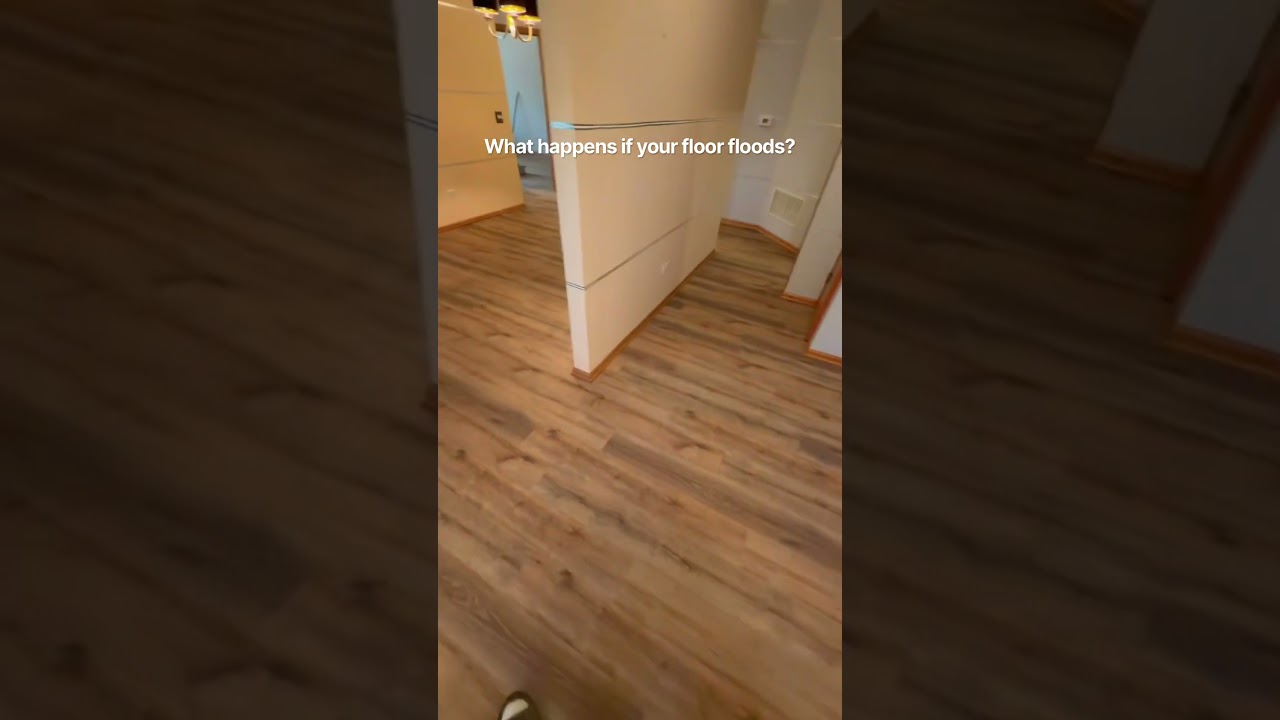
The posted title is only a date, October 25, 2026. The topic is in the pictures and the words. On-screen text asks what happens if your floor floods. The spoken answer is the install method, not a town name.
A bathroom frame shows a white toilet and a pedestal sink on light brown wood-look plank. Blinds cover a window. A hallway frame shows the same plank running to a door, with a ceiling light ahead. The opening frame shows the plank beside a white half wall. A shoe tip is at the bottom of that frame. No face is shown, and no town sign is in these frames. Mokena comes from the video description.
The photo on this page is a separate Floor 4U install. An installer in a Floor 4U shirt kneels at a wall beside gray wood-look plank, with a loose plank and a hammer nearby. That photo is not a frame from the Mokena walk-through, and it is not proof of this product’s color or glue.
How perimeter glue works on this floor
The narration is specific. These planks do not click together. They are not fully glued down. The crew perimeter glues them, just around the edges, to lock the floor in place. If a plank is damaged, or if there is a flood, they say you can lift that piece and swap it without tearing up the whole floor.
That is different from a click-lock floor, where the planks lock to each other and a repair often means releasing a run back to the damaged piece. It is also different from a full glue-down floor, where adhesive covers the field and a plank is bonded across its back. This clip does not show the glue bead, the trowel, or the open perimeter. The method is spoken. The frames show the finished plank.
Perimeter glue still has a job. It keeps the field from walking, and it holds the edges where the floor meets the wall. The center planks stay loose enough, on this system, to be lifted. Do not read that as “no adhesive anywhere.” The narration says the edges are glued.
If you are comparing this with a clicked plank in another room of your house, luxury vinyl flooring installation in Mokena is the service page for that conversation. Bring the product name. Click, full glue, and perimeter glue are not interchangeable repairs.
What Happy Feet publishes for Titan Sandy Mountain
The video description names Happy Feet Titan in Sandy Mountain, code HF640. The colorway page at happyfeetinternational.com/colorways/sandy-mountain-hf640, viewed 2026-11-25, titles the color Titan Sandy Mountain and shows HF640. No revision date was printed on that page.
The page lists the plank at 7 inches by 48 inches. The wear layer is 20 mil. Overall thickness is 4.5 mm. The edge is square. The finish is ceramic bead. Construction is listed as a commercial luxury vinyl plank with fiberglass reinforcement. The locking system is none. The install type is commercial loose lay or glue down.
The adhesive block on that page says two things at once. One line says adhesive is not required. The next lines name HF525Z primer with HF9200 spray adhesive or HF9100 transitional adhesive. This guide does not pick a winner between those lines. The Mokena narration is narrower: this house used perimeter glue, not a full glue-down, and not a click lock. The clip does not name HF525Z, HF9200, or HF9100, so those codes stay on the maker’s page.
The clip also does not measure 4.5 mm or 20 mil. Those numbers are the maker’s published specs, not a tape reading from the bathroom. A box label on your job is the check that the plank in the house is the plank on the page. The page lists 10 planks and 23.36 square feet in a box. That is packaging, not the size of this house.
Why some rooms got half-inch plywood
Some rooms sat lower than the others. The narration says the crew added half-inch plywood to build them up, so the whole house flows as one floor with no awkward transitions. The description says the same thing: half-inch plywood in lower areas, to bring the floors to the proper height.
The frames we reviewed do not show the plywood. They show the finished plank in the bathroom, the hallway, and the room with the half wall. Treat the plywood as what the crew said they did, not as a layer you can see in the picture.
Half an inch is a real height change. Doors, appliances, and transitions to rooms that are not getting this floor all feel it. Adding plywood is a subfloor decision, not a trim decision. Our subfloor prep and floor leveling page for Mokena is the guide for that work. This video is one example of building a low room up so a loose-lay field can stay one height.
It is not the same job as plywood after tile comes out. That guide is about the substrate left behind when tile and mortar are removed. This clip does not say tile was removed. It says some rooms were lower, and plywood brought them up. Use the page that matches the work in your house.
Kitchen and bathroom on one floor
The narration says the floor is waterproof, so it runs through the kitchen and the bathroom in this walk-through, with no stopping and starting at doorways. The bathroom is visible: toilet, pedestal sink, and the plank. The kitchen is not in the frames reviewed for this page. The kitchen claim stays with the narration and the description, which says one continuous floor through the living areas, the kitchen, and the bathroom.
A continuous field is the point of a loose-lay plank that does not stop at the bath door. It is also why the height work matters. If the bath sits lower and the plank has to climb a ridge at the door, the “no stopping” line fails even when the product is rated for wet rooms.
Bathroom floors have their own details: the toilet flange, the vanity, and the wet use around the tub or shower if those are in the room. This clip shows a toilet and a sink, not a tub. For the room itself, see bathroom floor installation in Mokena. For the kitchen the narration includes, see kitchen flooring installation in Mokena.
Two area figures, one job
The narration says almost 1,800 square feet, in two days, start to finish. The description says approximately 1,877 square feet of waterproof loose-lay LVP, installed in two days. Both numbers are from The Floor 4U. They are close. They are not the same sentence.
Use the written description when you need the tighter figure, and keep the spoken line as “almost 1,800.” Do not average them. Waste, closets, and the plywood rooms can move a takeoff. The two-day line is about this crew on this house. It is not a rate you can copy onto a different floor plan.
What a flood line does not promise
The on-screen question is what happens if your floor floods. The spoken answer is access. Because the planks are not locked and not fully glued, one piece can be lifted and swapped. That can open the subfloor for a look, and it can replace a damaged plank without pulling the whole field.
The description adds the limit that matters. Waterproof flooring does not mean the subfloor is protected from water damage. A plank that sheds a spill on top is not a lid that keeps flood water out of the plywood or the slab. If water sits under the floor, the plank being waterproof does not dry the wood.
Lifting a plank is also not the same as putting that same plank back after a dirty-water event. This clip does not say every flooded plank is reusable. It says you can lift a piece and swap it. Swap means a replacement piece, not a promise that the wet plank goes back down. How far that goes depends on the water, the substrate, and the shape of the plank after it dries. This page does not turn that into a cleanup plan.
A different loose-lay product can raise the same access question with different rules. Do not paste this perimeter-glue description onto another Happy Feet line. Read that product’s page, and keep this page tied to Titan Sandy Mountain as it was installed here.
What to check before you order
Start with the install type you actually want. If you need to lift a single plank later, say that before the glue plan is set. A full-spread glue-down will not give you the lift this narration describes. A click-lock floor will not either. Perimeter glue is the method this house used.
Measure the low rooms before you buy plywood. Half an inch fixed the step in this story. Your low spot may be less, or more, and it may be a dip in the middle rather than a whole room. The maker’s 4.5 mm plank will not erase a half-inch room difference by itself.
Check the wet rooms on the plan. If the plank is supposed to run through a bath or a kitchen without a break, the height at those doors has to be part of the same field. Confirm the box is HF640 if Sandy Mountain is the color you walked on. Confirm the wear layer and thickness on the box against the colorway page, since the clip does not show them.
Ask what “waterproof” covers in writing. On this job it covers the plank and the choice to run it through the kitchen and bathroom. It does not cover the subfloor under a flood. If a room has had water before, say so at the measure. The glue line and the plywood are easier to plan before the furniture is back.
Questions about perimeter glue loose-lay vinyl
Does perimeter glue mean no adhesive at all?
Not on this job. The narration says the planks are not fully glued down, and that glue is used around the edges to lock the floor. The Happy Feet colorway page lists Titan as loose lay or glue down and also names primer and adhesive products. The clip itself only describes perimeter glue.
Can one Titan Sandy Mountain plank be lifted if it is damaged?
On this Mokena install, the narration says yes. The planks do not click, and they are not fully glued, so a damaged piece can be lifted and swapped without tearing up the whole floor. That is this perimeter-glue job, not a rule for every loose-lay product.
Does a waterproof plank protect the subfloor in a flood?
No. The video description says waterproof flooring does not mean the subfloor is protected from water damage. The plank can be lifted for access. That does not dry the plywood or the slab underneath.
Why was half-inch plywood used in some rooms?
The narration and the description say some rooms sat lower. Half-inch plywood built those rooms up so the floor could run as one field without an awkward step. The reviewed frames show the finished plank, not the plywood.
Plan the glue line with us
You can see the rooms in person. During a free in-home estimate, we measure the low spots, the bath, and the kitchen doors, and we talk through perimeter glue versus a clicked or fully glued plank. There is no pressure to buy.
Share
Recent Posts

November 25, 2026
Perimeter Glue for Loose-Lay Luxury Vinyl Plank
Perimeter glue holds loose-lay luxury vinyl plank at the edges. See how Happy Feet Titan Sandy Mountain was installed in a Mokena, Illinois...
November 25, 2026
Happy Feet Titan Sandy Mountain in a Mokena Home
Watch Happy Feet Titan Sandy Mountain, a loose-lay luxury vinyl plank, in a Mokena, Illinois home. Perimeter glue lets one damaged plank lift...
November 25, 2026
Matching Luxury Vinyl Plank Height to Tile or Hardwood
When luxury vinyl plank meets tile or hardwood, the finished heights decide the step. See how 11.5 mm Happy Feet Sussex met kitchen...